
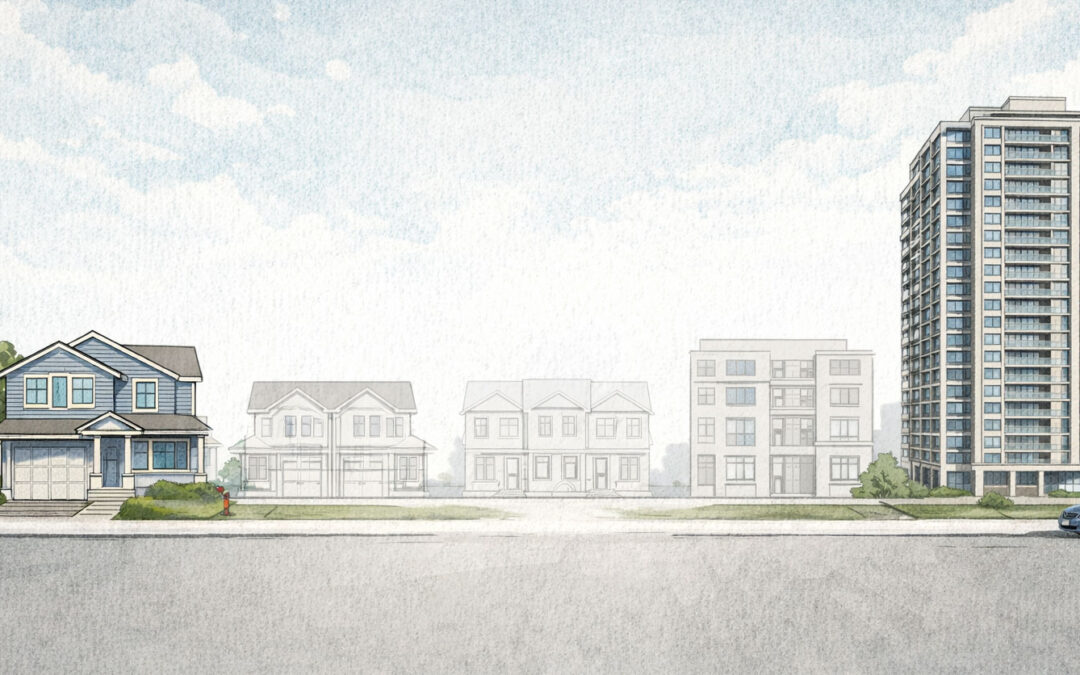
If you follow housing policy in Ontario, you have probably heard the phrase “the missing middle” more than a few times over the last couple of years. It has become something of a rallying call for planners, advocates, and municipal councils trying to thread the needle between sprawl and densification. But what does it mean, and why has it become so central to how communities like ours are thinking about housing?
The answer is rooted in history, in policy choices, good and bad, made decades ago that shaped the built form of nearly every North American city. Understanding those choices, and the effort now underway to reverse them, is essential context for anyone working in development, planning, or municipal policy today.
What Is the Missing Middle?
The missing middle refers to the range of housing types that sit between the detached single-family home and the large mid- or high-rise apartment building. Think duplexes, triplexes, four-plexes, townhouses, multiplexes, small courtyard apartments, and live-work units. These are house-scale buildings with multiple units, typically in walkable, transit-accessible locations. For a detailed primer, Missing Middle Housing has been a widely referenced resource in both planning and policy circles.
These housing types are not new. Before the mid-twentieth century, they were common throughout older urban neighbourhoods across North America. What happened after that is largely a story of zoning policy.
Why Did It Disappear?
Post-war zoning in North America created a rigid binary. Land was classified as single-family residential or as a higher-density zone that accommodated large apartment buildings. The in-between forms, those duplexes and small courtyard apartments that once filled entire city blocks, were effectively made illegal or so difficult to build that developers simply did not pursue them.
The result was predictable. Cities polarized. Low-density suburbs expanded outward while high-density nodes concentrated in specific corridors. The gentle, medium-scale infill that had historically housed a significant portion of the population had nowhere to go. Over decades, that housing stock aged, was not replaced, and the pipeline for building new versions of it dried up entirely.
The consequences are now widely felt. Housing costs have risen sharply in cities of all sizes. Families who cannot afford a detached home and do not want a high-rise apartment have few options. Seniors looking to downsize within their own neighbourhood have nowhere to go. Young professionals, new Canadians, and moderate-income households are being priced out of communities they are already part of.
The in-between forms that once filled entire city blocks were effectively made illegal. Over decades, that housing stock aged, was not replaced, and the pipeline for building new versions of it dried up entirely.
Why Planners and Policy Makers Are Paying Attention Now
Missing middle housing has moved to the centre of the policy conversation because it offers something relatively rare in urban planning: a solution that addresses multiple problems at once without requiring dramatic changes to the character of existing neighbourhoods.
Adding a four-plex on an existing residential lot increases housing supply without requiring a tower. Permitting a small courtyard apartment near a transit stop serves multiple household types without changing the streetscape in ways most residents would find alarming. This is the concept of gentle density, and it is increasingly seen as a core tool in addressing affordability while respecting community context.
Missing middle housing also aligns naturally with transit-oriented development goals. Smaller, walkable, multi-unit buildings placed near transit stops and daily services reduce car dependence, support local businesses, and build the kind of neighbourhood vibrancy that makes communities genuinely livable over time.
Beyond supply, there is an equity dimension that planning advocates have been consistent about. Single-family zoning did not emerge in a vacuum. Its history is entangled with exclusionary practices that deliberately kept certain populations out of certain neighbourhoods. Reforming it is not just a housing supply question. It is, for many, a question of who gets to live where.
What Is Happening in Ontario, and in Waterloo Region Specifically
Ontario has been moving on this, albeit unevenly. Toronto’s Expanding Housing Options in Neighbourhoods (EHON) initiative opened as-of-right permissions for up to four units on residential lots, creating meaningful precedent. The province’s broader push to streamline approvals and remove barriers to infill has created policy space that municipalities are using in different ways.
Waterloo Region is one of the more active examples in the province. The City of Kitchener passed its Missing Middle and Affordable Housing Community Improvement Plan in December 2025, introducing incentives and enabling multiplexes in areas where they were previously not permitted. The City of Waterloo’s Housing Accelerator Fund agreement with the federal government, finalized in 2024, enabled as-of-right permissions for up to four units and buildings of up to four storeys in low-density areas.
Perhaps the most ambitious initiative in the Region is BUILD NOW, a partnership led by Habitat for Humanity with support from the University of Waterloo and community stakeholders. The initiative targets 10,000 ownership-focused missing middle homes by 2030, with a specific focus on family-sized units. Seventy percent of those units are intended to be ownership, addressing a persistent gap in the Region’s housing mix where rental and high-rise supply has grown but family-sized ownership options remain scarce.
These initiatives reflect a Region that is serious about the problem. They also reflect how complex it is to solve.
The Barriers Are Real and Multi-Layered
Zoning reform is necessary but not sufficient. Even where municipalities have updated their official plans and zoning bylaws, the economics of building missing middle housing remain difficult. Developer fees, impact charges, and permitting timelines that were designed for large-scale apartment or subdivision projects do not translate well to smaller infill builds. The financial model for a four-plex in a residential neighbourhood is fundamentally different from a 200-unit tower, and the financing and approval systems have not caught up.
Community opposition remains a genuine obstacle, though its shape has changed. Neighbours can no longer directly appeal planning applications and decisions the way they once could, but that has not eliminated the influence. It has simply moved it upstream, into public consultations, council chambers, and the political pressure that shapes how elected officials approach intensification. Concerns about parking, neighbourhood character, and the pace of change are real, and they do not disappear because the appeal mechanism has been narrowed.
What they do is slow things down in ways that are harder to trace and harder to address.
This matters because the population that raises those concerns is largely the same one that says it wants more housing. According to research cited by the Region’s own planning documents, 38 percent of Waterloo Region residents are in housing they cannot comfortably afford, while 63 percent say they support more missing middle development. The tension between those numbers is not hypocrisy. It reflects how difficult it is for communities to reconcile abstract support for housing with concrete change on their own streets, and it is where some of the most important planning and engagement work actually happens.
There is also a supply-demand mismatch that zoning alone cannot fix. Transit-oriented development in the Region has largely produced one and two-bedroom apartments. The family-sized three and four-bedroom missing middle units that would allow households to stay in established, transit-connected neighbourhoods as they grow are not being built at meaningful scale. The regulatory environment has historically not supported it, and the builder community has not developed the expertise or appetite for smaller-scale infill at volume.
38 percent of Waterloo Region residents are in housing they cannot comfortably afford, while 63 percent say they support more missing middle development. That gap is where a lot of planning work happens.
What Getting It Right Actually Takes
The cities that have made real progress on missing middle share a few common characteristics. They paired zoning reform with community engagement that was substantive, not performative. They used data to shift the narrative from fear of change to the real cost of inaction. And they created financial incentives that made the economics of smaller infill builds viable for developers who do not have the scale to absorb high carrying costs and uncertain timelines.
In Waterloo Region, initiatives like the Sugarbush South Corridor Expansion Study and the Housing Accelerator Fund work are attempting exactly that combination. The WRYIMBY coalition has been active in pushing back on regulatory barriers and advocating for stronger renter protections alongside supply growth. These are not simple, single-lever problems, and the communities making the most progress are treating them accordingly.
For the development and planning community, the lesson is that missing middle housing requires a different kind of expertise than either large-scale subdivision development or high-rise intensification. It demands fluency in infill approvals, sensitivity to neighbourhood context, and the ability to make the financial case for projects that do not fit the standard developer playbook. Urban Initiatives has written about the broader challenges of navigating Ontario’s planning approvals environment and how strategic positioning from the outset changes outcomes.
A Defining Question for the Next Decade
The missing middle is not a niche planning concept anymore. It is one of the central questions shaping how Ontario communities grow, who gets to live in them, and whether the housing system can serve the full range of households that make up a healthy community.
Waterloo Region has made a meaningful start. The policy framework is moving in the right direction. The advocacy community is engaged and informed. The question now is whether the planning and development ecosystem can produce the projects at the scale and affordability that the Region actually needs.
That is a hard question, and it does not have a simple answer. But it is the right question to be asking, and it will define a significant part of the built environment in this Region for decades to come.